
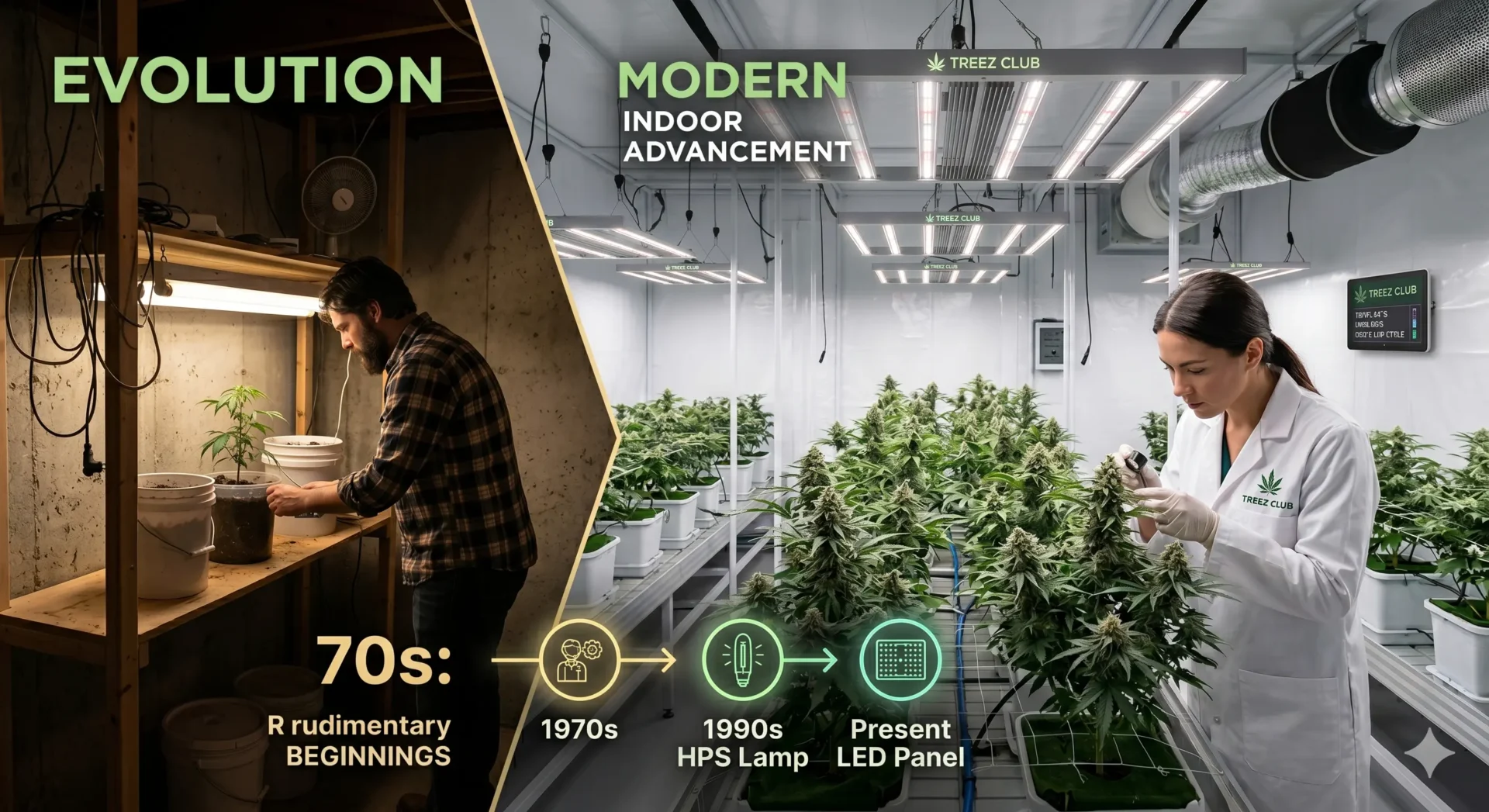
Indoor cannabis cultivation has undergone a remarkable evolution, from its clandestine beginnings to a highly developed practice. Technological advances, regulatory changes and growing consumer demand have all played a significant role in how cannabis is grown indoors today. The Trinity of Modern Cultivation – Handbook by Treez Tools details the history and evolution of indoor cultivation, providing valuable insight into today’s practices and future trends.
How did indoor cannabis cultivation begin?
The roots of indoor cannabis cultivation date back to the late 1960s and early 1970s, when cannabis enthusiasts had to avoid growing outdoors due to strict legal restrictions. In response, the pioneers of the cannabis movement began experimenting with indoor cultivation methods to grow their plants discreetly and out of sight of the authorities. At the time, tools and knowledge for indoor growing were limited, and growers had to make do with simple light bulbs and basic setups.
These early experiments often took place in basements, cupboards or attics, with minimal ventilation and simple irrigation systems. As growers began to share their knowledge, techniques gradually evolved. Simple reflective materials such as aluminum foil were used to improve light distribution, and household fans helped to promote air circulation and control humidity. Although these methods were rudimentary, they laid the foundation for today’s advanced growing practices.
The role of technology in the transformation of indoor cannabis cultivation
In the late 1980s and 1990s, technology began to meet the needs of indoor growers. The introduction of high intensity discharge (HID) lamps, such as metal halide (MH) and high pressure sodium (HPS) lamps, was a major breakthrough. These lamps mimicked the intensity and spectrum of natural sunlight, allowing cannabis plants to grow more vigorously indoors. Hydroponic systems also gained popularity during this time, offering a more efficient way to provide nutrients to plants without the use of soil.
Advances in climate control technology further transformed cultivation. Growers could now precisely regulate temperature, humidity and CO2 levels to create ideal growing conditions. These innovations led to bigger, healthier plants and significantly improved yields.
Legalization and commercialization of indoor cannabis cultivation
The legalization of cannabis in many parts of the world, especially in North America, has brought indoor cannabis cultivation into the mainstream. No longer just an underground activity, cannabis cultivation has become a legal and highly profitable industry. This change has led to the development of large-scale, state-of-the-art indoor facilities that rely on cutting-edge technology and automation.
Today’s commercial cannabis growers use advanced LED lighting systems, automated irrigation and sophisticated climate controls to optimize every aspect of the growing process. As emphasized in the Trinity of Modern Cultivation handbook, these technologies not only increase yield, but also improve the quality of the cannabis as the plants produce more potent cannabinoids and richer terpene profiles.
The future of indoor cannabis cultivation
As indoor cannabis cultivation evolves, sustainability and energy efficiency are coming to the fore. Growers are increasingly turning to LED lights, which consume less energy and generate less heat than traditional HIDs, reducing the need for additional cooling systems. Automation and data-driven growing systems are also playing a greater role, allowing growers to monitor and adjust their growing environments in real time.
The industry is expected to see further advances in genetics, with growers focusing on developing varieties that thrive indoors and produce higher yields in small spaces. The ongoing evolution of indoor cannabis cultivation promises to make growing more efficient, sustainable and accessible for both commercial and hobby growers.